 |
| Dandelion treats many conditions. |
Showing posts with label inflammation. Show all posts
Showing posts with label inflammation. Show all posts
Dandelion Treats 14 Medical Conditions
Tart Cherries Reduce Inflammation and Arthritis Pain
 |
| Tart cherries help ease the pain of arthritis. |
Ampelopsis japonica Halts Breast Cancer Metastasis

The more we research plant medicines among human cancer cell lines, the more we find that so many plant medicines will halt and even eliminate cancerous cells and tumors before they rage out of control.
Aloe Successfully Treats Oral Conditions Caused by Betel Chewing

Noni Lowers Inflammation, Triglycerides, Cholesterol
 |
| Noni fruit reduces inflammation and cholesterol. |
Nuts Feed Probiotics, Yield Heart Benefits
 |
| Nuts boost heart health. |
Switch to Brown Rice Drops Weight and Reduces Inflammation
[caption id="attachment_8300" align="alignleft" width="320"] Photo by Aditya Srinivasan[/caption]
Most health foodies know that brown rice is better than white rice.
But new research from the Isfahan University School of Medicine has found that brown rice not only contains more nutrients, but helps drop the pounds and reduce inflammation.
In a six-month cross-over study, 40 obese or overweight women with a body mass index of at least 25 ate either brown rice or white rice. Outside of the type of rice, their diets matched in other respects. Both diets maintained 50-60% carbohydrates, 15-20% protein and less than 30% fats. The subjects each ate 150 grams of cooked rice, either white or brown rice, supplied by the researchers.
The subjects were divided into two groups. For the first six weeks, one group ate the brown rice and another ate the white rice in their diet.
After a two week break (wash-out period), the groups switched. The white rice group ate the brown rice and vice versa.
The subjects were each tested before and after each period. They were tested for weight, BMI, waist and hip circumference, blood pressure, cholesterol, glucose levels and C-reactive protein (CRP) - a marker for inflammation.
The research found that those eating the brown rice during each group had lose more weight and waist and hip circumference, as well as had reduced inflammation compared with the white rice group.
The brown rice groups had an average of 1.2 kilograms lower weight (about 2.6 lbs.), 2.38 centimeters less waist circumference, 3 cm reduced hip circumference and .52 kg/m2 less BMI on average. The brown rice group also had 0.98 mg/L less CRP levels compared with the white rice group.
Brown rice contains many nutrients and antioxidants
Brown rice typically contains significantly more nutrients than white rice, including vitamins, minerals, dietary fiber and essential fatty acids. Other research has confirmed brown rice’s ability to reduce blood glucose and increase insulin sensitivity, as well as reduce LDL-cholesterol levels.
A study from Portugal’s Centre for the Research and Technology of Agro-Environment and Biological Sciences studied brown rice compounds and found that they contain a variety of antioxidants, including phenolic acids, flavonoids, anthocyanins, proanthocyanidins, tocopherols and tocotrienols. The later two are considered vitamin E – superior to synthesized versions.
This latter study also found that darker varieties of rice contained more antioxidants than lighter colors. Their rating went from black rice with the most antioxidants, with purple rice, red rice and brown rice following in order of antioxidant levels.
They also found that Japonica rice varieties had the highest antioxidant levels compared to the more commercial Indica varieties.
REFERENCES:
Kazemzadeh M, Safavi SM, Nematollahi S, Nourieh Z. Effect of Brown Rice Consumption on Inflammatory Marker and Cardiovascular Risk Factors among Overweight and Obese Non-menopausal Female Adults. Int J Prev Med. 2014 Apr;5(4):478-88.
Goufo P, Trindade H. Rice antioxidants: phenolic acids, flavonoids, anthocyanins, proanthocyanidins, tocopherols, tocotrienols, γ-oryzanol, and phytic acid. Food Sci Nutr. 2014 Mar;2(2):75-104.
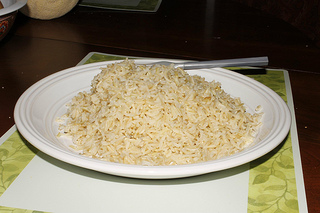 Photo by Aditya Srinivasan[/caption]
By Case Adams, Naturopath
Most health foodies know that brown rice is better than white rice.
But new research from the Isfahan University School of Medicine has found that brown rice not only contains more nutrients, but helps drop the pounds and reduce inflammation.
In a six-month cross-over study, 40 obese or overweight women with a body mass index of at least 25 ate either brown rice or white rice. Outside of the type of rice, their diets matched in other respects. Both diets maintained 50-60% carbohydrates, 15-20% protein and less than 30% fats. The subjects each ate 150 grams of cooked rice, either white or brown rice, supplied by the researchers.
The subjects were divided into two groups. For the first six weeks, one group ate the brown rice and another ate the white rice in their diet.
After a two week break (wash-out period), the groups switched. The white rice group ate the brown rice and vice versa.
The subjects were each tested before and after each period. They were tested for weight, BMI, waist and hip circumference, blood pressure, cholesterol, glucose levels and C-reactive protein (CRP) - a marker for inflammation.
The research found that those eating the brown rice during each group had lose more weight and waist and hip circumference, as well as had reduced inflammation compared with the white rice group.
The brown rice groups had an average of 1.2 kilograms lower weight (about 2.6 lbs.), 2.38 centimeters less waist circumference, 3 cm reduced hip circumference and .52 kg/m2 less BMI on average. The brown rice group also had 0.98 mg/L less CRP levels compared with the white rice group.
Brown rice contains many nutrients and antioxidants
Brown rice typically contains significantly more nutrients than white rice, including vitamins, minerals, dietary fiber and essential fatty acids. Other research has confirmed brown rice’s ability to reduce blood glucose and increase insulin sensitivity, as well as reduce LDL-cholesterol levels.
A study from Portugal’s Centre for the Research and Technology of Agro-Environment and Biological Sciences studied brown rice compounds and found that they contain a variety of antioxidants, including phenolic acids, flavonoids, anthocyanins, proanthocyanidins, tocopherols and tocotrienols. The later two are considered vitamin E – superior to synthesized versions.
This latter study also found that darker varieties of rice contained more antioxidants than lighter colors. Their rating went from black rice with the most antioxidants, with purple rice, red rice and brown rice following in order of antioxidant levels.
They also found that Japonica rice varieties had the highest antioxidant levels compared to the more commercial Indica varieties.
REFERENCES:
Kazemzadeh M, Safavi SM, Nematollahi S, Nourieh Z. Effect of Brown Rice Consumption on Inflammatory Marker and Cardiovascular Risk Factors among Overweight and Obese Non-menopausal Female Adults. Int J Prev Med. 2014 Apr;5(4):478-88.
Goufo P, Trindade H. Rice antioxidants: phenolic acids, flavonoids, anthocyanins, proanthocyanidins, tocopherols, tocotrienols, γ-oryzanol, and phytic acid. Food Sci Nutr. 2014 Mar;2(2):75-104.
Goldenseal Proves to be Antibiotic and Antiviral

Despite the research proving that antibiotics are producing more deadly superbugs, antibiotic medications are still prescribed for even the most easily conquered bacterial infection.
Subscribe to:
Posts (Atom)